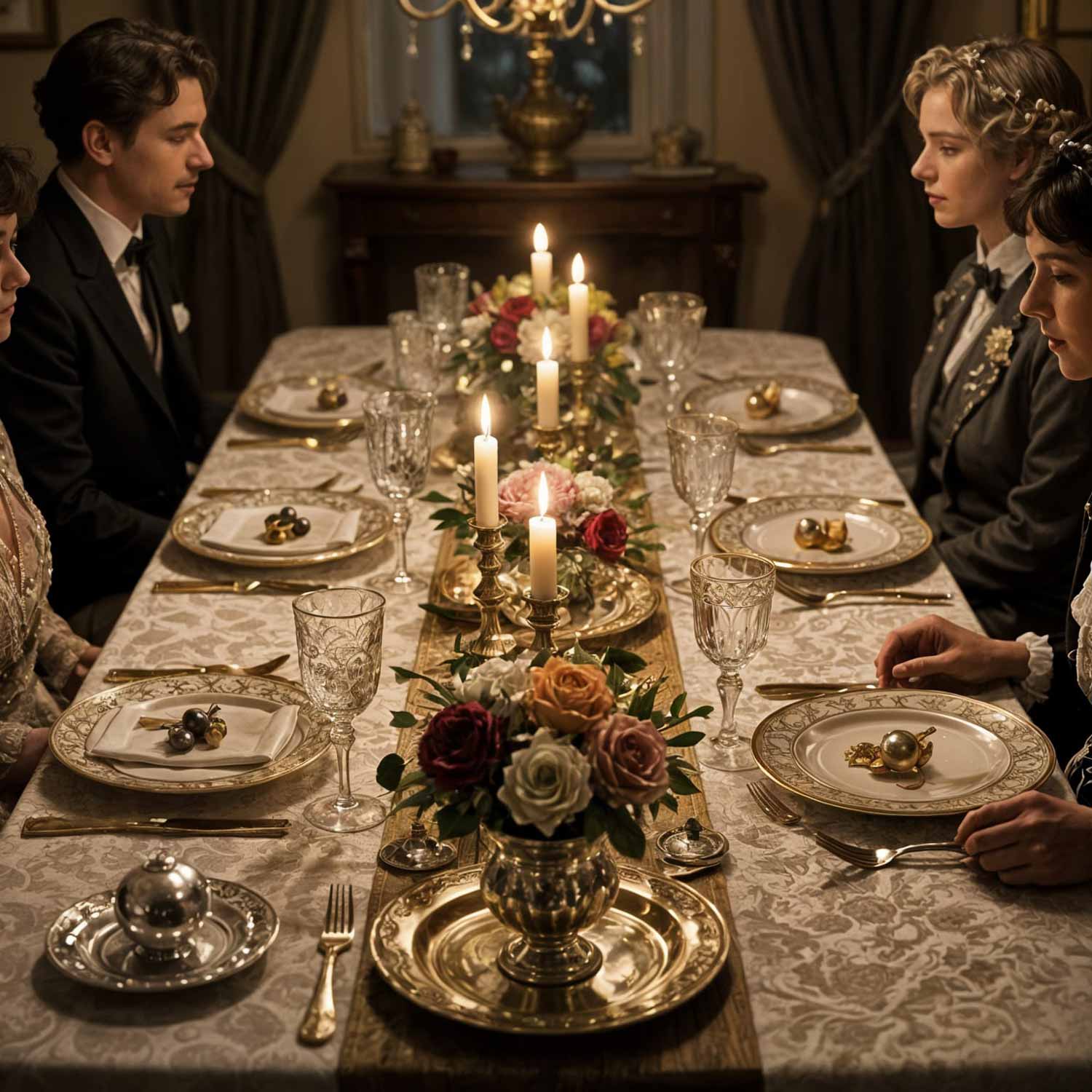
People sometimes ask us where our games come from. Not in a philosophical sense, more in a genuinely curious, slightly suspicious way, as if they expect us to admit that we have a warehouse full of chained-up thriller writers producing scripts on a conveyor belt.
The answer is considerably less gothic than that, but no less interesting.
Writing a murder mystery party game is one of the stranger creative challenges out there. It's not quite like writing a novel. It's not quite like writing a play. It sits in a peculiar space between the two, with additional complications borrowed from game design, social dynamics, and the eternal human question: will Janet actually play along, or will she spend the whole evening sitting with her arms folded?
Here's a look at some of what goes into it, though we'll be keeping a few trade secrets firmly in the vault.
It Starts With A Body (Obviously)
Every murder mystery begins with a death. That's non-negotiable. But before we can write a single word of character dialogue or plant a single clue, we need to know who died, why, and crucially, who wanted them dead, and can we make that plausible for at least six different people simultaneously?
That last part is where things get complicated.
In a novel, you need one killer with one motive. In a party game, you need every single guest to have a credible reason to have committed the murder. Not because they all did it (that would be a very different kind of evening), but because the game only works if no one can be immediately and obviously ruled out. The moment someone can say, "Well, I clearly didn't do it because I had no motive," the whole thing collapses.
So before a word of the actual game is written, we need a cast of characters who are all, plausibly, capable of murder. Which is either a cheerful, creative exercise or a slightly worrying insight into how we spend our time, depending on how you look at it.
Characters Have To Work On Two Levels
This is something players rarely think about, but it's one of the things that makes or breaks a mystery game: every character has to work as themselves, and also as a suspect.
As themselves, they need to be interesting, playable, and fun. Nobody wants to spend three hours being "Gerald, the accountant who doesn't say much." Characters need personality, quirks, and something to actually do during the evening. They need dialogue hooks, opinions, and relationships with other characters. They need to feel like a real person at this fictional gathering, not a narrative function.
As suspects, they need secrets. Not one secret, several. Some relevant to the murder. Some not. Because part of the art is making players chase red herrings without ever feeling cheated. The secrets that turn out to be irrelevant to the crime still need to feel meaningful, or the guest playing that character will feel like they contributed nothing.
Layering all of that into a single character description, and then doing it for six, eight, or ten characters simultaneously, while making sure none of the secrets contradict each other across the whole cast, that's where the real work lives.
The Clue Architecture
We're going to be deliberately vague here, partly because this is genuinely complex and partly because it's something we'd rather keep to ourselves.
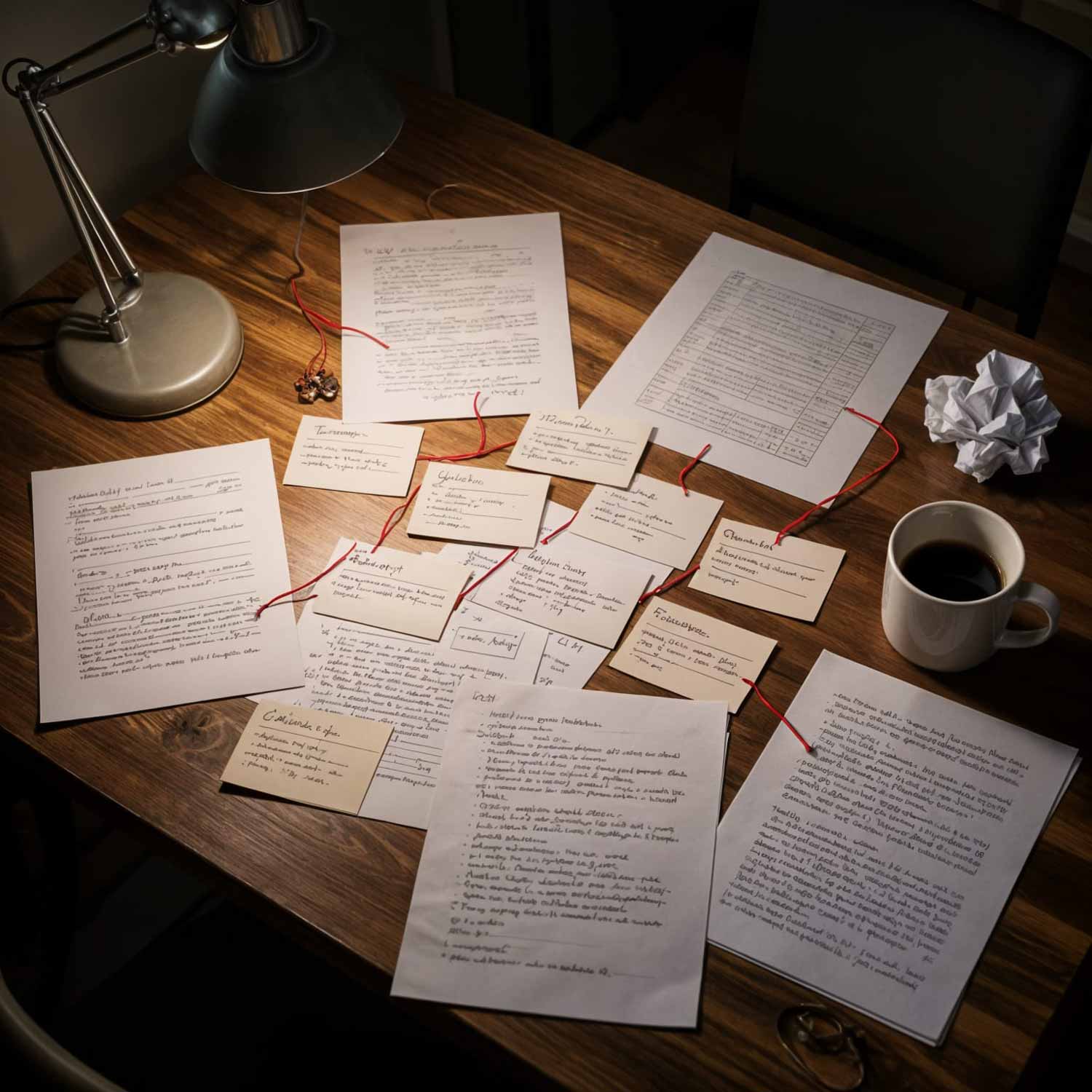
What we will say is that clues in a good mystery game are not just facts. They're decisions. Every piece of information a player can discover needs to have been placed there deliberately, with a clear understanding of what it confirms, what it might suggest, and what it absolutely must not give away too early.
A clue that makes the murderer obvious in round one is a disaster. A clue that never meaningfully points toward anyone is a waste of paper. A clue that seems to implicate someone innocent, convincingly, for just long enough, is gold.
Getting that balance right involves a lot of internal playtesting, a lot of revision, and the occasional moment of staring at a spreadsheet at eleven at night and wondering why you thought a locked-room element was a good idea.
The Problem Of The Ending
Here's something that surprises people: the ending is often the hardest part to write.
Not because it's difficult to decide who did it, that's decided very early, at the structural stage. The challenge is making the final revelation feel earned without making it feel obvious in retrospect.
The best mystery endings produce that specific double reaction: first disbelief (really?), then immediate recalibration (oh, but of course, because of the thing with the...). Achieving that requires the clues to have been arranged so that, when the reveal arrives, players can immediately see how they fit together, but only in that moment, not before.
That's a narrow target to hit. Too many obvious clues, and the killer is spotted an hour before the finale. Too few, and the ending feels arbitrary, like the murderer was chosen at random. We aim for the sweet spot, miss it sometimes in early drafts, and revise until it lands.
Playtesting Is Where You Find Out What You Got Wrong
No game goes from first draft to finished product without a significant amount of humbling feedback.
Playtesting a murder mystery game is a particular experience. You sit in the corner, trying to look casual, watching a group of people encounter your work in real time. You watch them miss the clue you thought was unmissable. You watch them correctly deduce the murderer through a chain of logic you never intended and couldn't have predicted. You watch the character you were most proud of get completely ignored because they were seated at the wrong end of the table.
Then you go home, and you rewrite.
The things playtesting reveals are rarely about the plot. The plot is usually fine. What playtesting reveals is the human problems: that guests don't read documents as carefully as you assumed, that a character with too many secrets becomes paralysing to play, and that the pacing of information release in round two feels like a traffic jam when experienced in real time.
Every game we've released has been through multiple rounds of this. Some have been substantially rebuilt as a result. It's not glamorous work, but it's the difference between a game that almost works and a game that really works.
The Thing We Think About Most
If we had to name the single thing that takes the most consideration in every game we make, it would be this: making sure that everyone at the table has a good time, regardless of whether they win.
Murder mysteries live or die on the experience of the guests, not just the outcome. A player who doesn't solve the mystery but spent the evening having interesting conversations, harbouring a delicious secret, and dramatically accusing the wrong person has had a wonderful time. A player who solves it but felt like they were doing homework hasn't.
That's the design challenge that never goes away, no matter how many games we write. The mystery is the structure. The fun is the thing we're actually trying to create.
And that, more than any specific technique or trick, is what we're always working on.