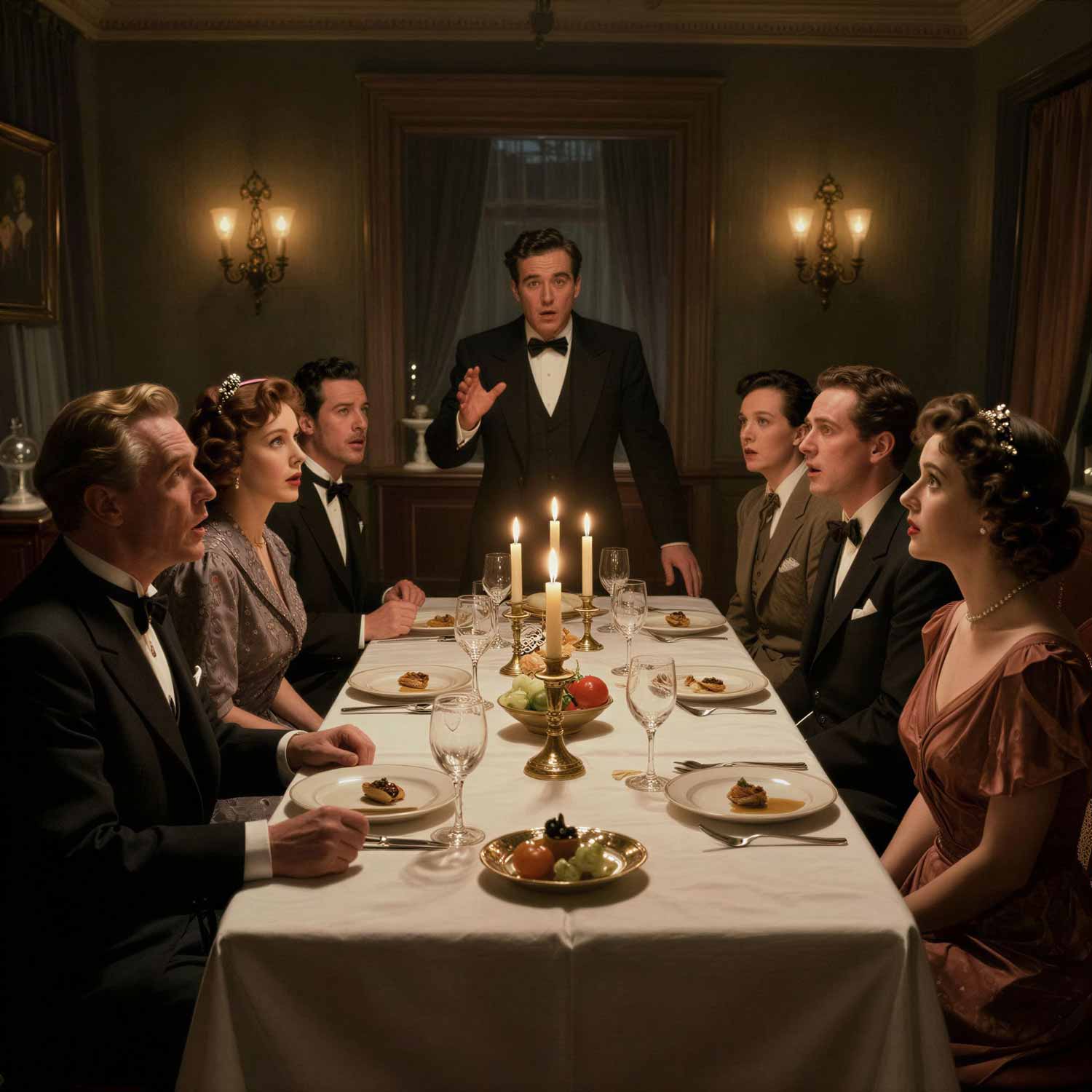
There is a moment at every murder mystery dinner party when someone leans back in their chair, narrows their eyes at the person accused of hoarding the good silverware, and announces, with total confidence, "I can always tell when someone's lying."
They cannot. Almost nobody can. And the research on this is not closed.
The Coin Toss You Didn't Know You Were Flipping
Across decades of studies, the picture that emerges is remarkably consistent. When people are asked to judge whether someone is lying or telling the truth, they get it right roughly 54% of the time. A coin has no opinions and would manage about 50%. That four-point margin is, essentially, the sum total of humanity's lie-detecting superpower.
This holds up whether the judge is a member of the public, a trained interviewer, or a police officer with years of experience reading suspects. Confidence and competence, it turns out, are only loosely acquainted. People who feel very sure they've spotted a liar are, on average, no more accurate than people who admit they're guessing.
The Tells You've Been Trusting Are Mostly Myths
Ask someone how they know a person is lying, and they will usually reach for the same handful of clues. Liars won't look you in the eye. Liars fidget. Liars get nervous and start talking too fast, or too slow, or touch their nose in a manner that would make a cartoon detective raise an eyebrow.
The trouble is that none of these behaviours reliably track with actual deception. Some people are naturally fidgety. Some people avoid eye contact because they're shy, or anxious, or simply thinking hard about their answer. A guilty person and an innocent person put in the same stressful spotlight often look remarkably similar, because it turns out that being accused of something is stressful regardless of whether you did it.
Verbal content tends to be a better indicator than body language, but even that requires more careful attention than most of us bring to a dinner conversation. Watching someone's hands rarely tells you what you think it does.
We're Built to Believe People, Not Doubt Them
Here's the part that explains a great deal about why we're so easily caught out. Researchers describe something called truth-default theory, and the idea at its core is refreshingly simple: humans walk into most conversations assuming the other person is being honest. We don't actively scan every sentence for deceit. We accept it, by default, unless something specific gives us a reason not to.
This is, on the whole, a sensible way to run a society. Constantly interrogating every claim your friends, colleagues, and family members make would be exhausting and would make you very poor company at a dinner party. The cost of this default setting, though, is that a well-constructed lie, delivered by someone with no obvious reason to deceive you, tends to sail straight through.
Where People Actually Get Better
There is one place the picture brightens considerably: familiarity. Parents, for instance, are often noticeably better than chance at spotting when their own children are lying, not because they've mastered some secret decoding skill, but because they know the baseline. They know how their child behaves when telling the truth, so a deviation from that pattern stands out.
This is a useful thing to hold onto. Detecting deception isn't really about reading universal signals. It's about noticing a change from what's normal for that specific person, in that specific context. Strangers don't give you that comparison, which is exactly why a table full of people you've never met before is such fertile ground for being fooled.
And Where Professionals Overcorrect
Interestingly, the people whose job it is to spot lies for a living don't automatically fare better. Some research suggests that trained professionals develop the opposite problem from the general public. Where most of us default to trusting people, professionals who spend their days looking for deception can tip into a lie bias, seeing suspicious behaviour everywhere they look, including in people who are simply nervous, tired, or bad at eye contact.
Once you're primed to expect a lie, you'll generally find evidence to support it, whether or not it's actually there.
Why Any of This Matters Around Your Dinner Table
All of which brings us back to that person leaning back in their chair, entirely convinced they've cracked the case through sheer force of intuition.
The genuinely interesting thing about a good murder mystery evening isn't that someone at the table is lying. It's that everyone at the table is operating with the same flawed equipment that the research describes. Nobody has a working lie detector. Everybody is defaulting to trust, reading tells that don't mean much, and mistaking their own confidence for accuracy.
That's precisely what makes a well-written mystery character so satisfying to play, and so maddening to sit opposite. A guest who's been given a genuine secret to protect, one with real texture and a plausible reason for the deflection, doesn't need to overact or twitch suspiciously to create tension. The tension is already built into the situation. Everyone at that table is trying to do something psychologists have spent a century confirming we're bad at, and they're trying to do it after two courses and a decent Malbec.
So next time someone insists they always know when a friend is bluffing, you now have the evidence to smile politely and disagree. And if you'd like to put that theory to the test properly, with characters designed to give even the most confident lie-spotter a genuinely difficult evening, that's rather our whole business.