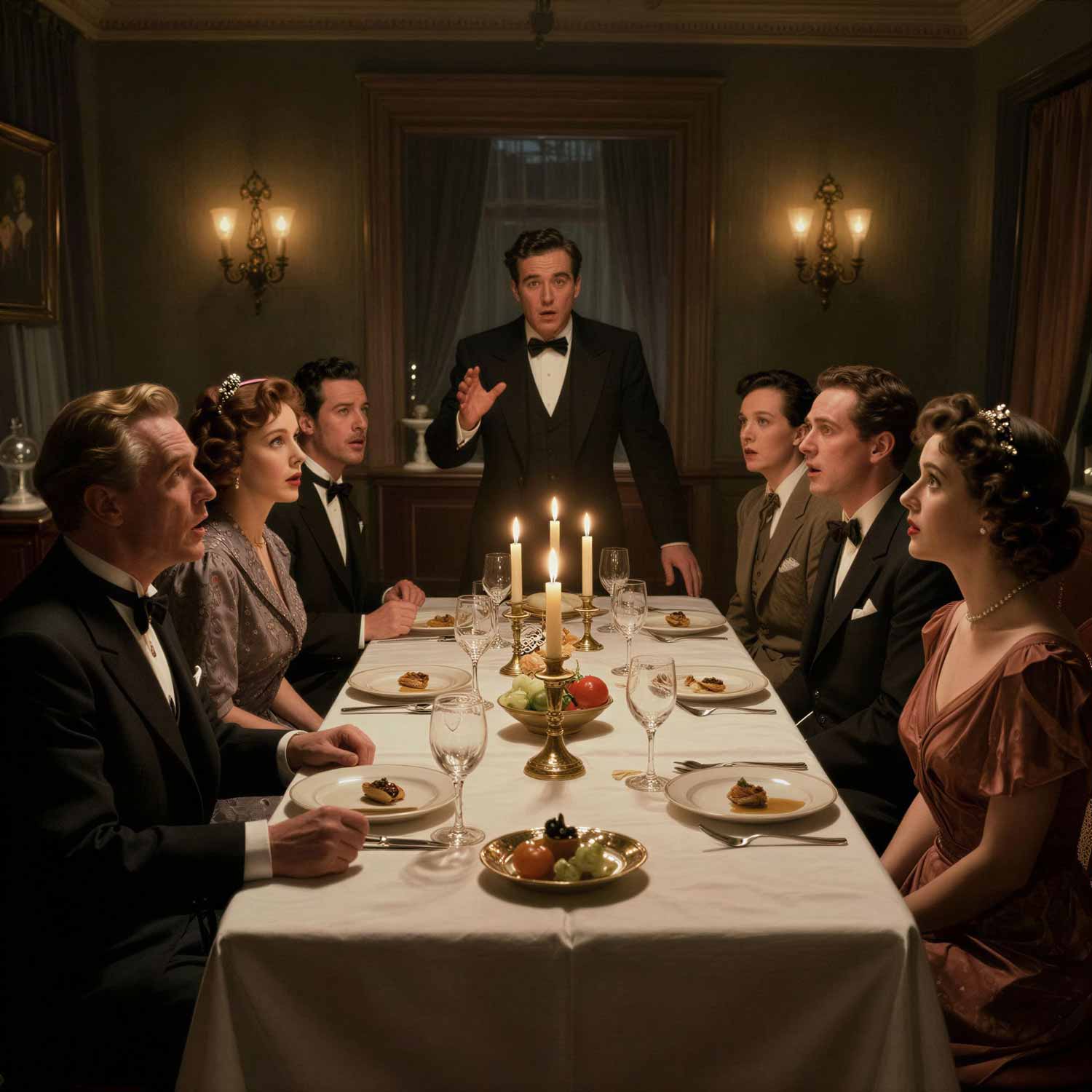
There's a particular kind of horror that lives in a locked room with six people, each with something to hide.
No monster. No sudden bang. No figure lurching out of a darkened doorway. Just the slow, creeping realisation that someone at the table is lying — and they've been lying very convincingly, possibly since the canapés.
That's suspense. And it's considerably more unsettling than anything that goes bump in the night.
Jump scares are cheap thrills. They work by hijacking your nervous system for about three seconds, and then everyone laughs awkwardly and moves on. Suspense is different. Suspense lingers. It makes your guests lean forward in their chairs. It makes them second-guess everything they thought they knew. It makes someone put down their glass of wine because their hand has gone slightly tense.
And the good news? You don't need a haunted house, a strobe light, or a person in a rubber mask to create it. You just need to understand what suspense is actually made of.
Let's get into it.
Suspense Is About What You Don't Know (Yet)
The single biggest misconception about suspense is that it requires something frightening to happen. It doesn't. Suspense is the gap between what your guests know and what they suspect — and the growing, itching, irresistible need to close that gap.
Hitchcock — the undisputed king of suspense — explained it beautifully. If two people are sitting at a table talking about the weather, and a bomb goes off, that's surprise. But if the audience can see the bomb under the table, ticking, while the characters chat obliviously? That's suspense. The explosion is almost secondary.
In a murder mystery game, you have this same tool at your disposal. Your guests know a murder has occurred. They know one person in the room is responsible. They're sitting at the table, eating their dinner, talking to suspects — and the whole time, that bomb is ticking away underneath.
You haven't done anything scary. You've just created a situation where not knowing feels almost unbearable.
The Art of the Well-Placed Silence
One of the most underestimated tools in a murder mystery host's arsenal is the pause.
Not an awkward one — a deliberate one. The moment after someone reveals a surprising piece of information, when you let the room absorb it rather than rushing to fill the quiet. The beat where a suspect finishes answering a question and everyone's eyes slide slightly sideways, checking each other's reactions.
Silence is uncomfortable. Human beings are wired to fill it. And that discomfort — that low-grade social pressure — translates directly into tension. Without anyone screaming or a single violin sting.
If you're hosting a dinner party mystery, this is your superpower. You can control the rhythm of the evening. When something significant is revealed, resist the urge to immediately move on. Let it sit there. Watch your guests get uncomfortable. That discomfort? That's suspense.
Give People Incomplete Information
Here's the thing about knowing everything: it's very relaxing. You can sit back, feel confident, and enjoy your meal.
Here's the thing about knowing almost everything: it's absolutely maddening.
The most effective murder mysteries drip-feed information in a way that constantly shifts what your guests think they know. They become convinced of one theory — then a new clue arrives that makes the whole thing wobble. They were certain it was the housekeeper. Now they're not so sure. Now they're very sure again, but in a completely different direction.
This is suspense. Not through terror, but through carefully managed uncertainty.
In a well-designed mystery game, this is baked into the structure — clues are revealed in rounds, characters have information that other characters don't, and the picture only becomes clear (or clearer, at least) towards the end. But as a host, you can amplify this effect by the way you time revelations, the moments you choose to hand out new information, and the occasions where you let guests marinate in their current state of confusion for just a little longer than is entirely comfortable.
Characters Who Are Clearly Hiding Something
There is a peculiar tension that arises when you're talking to someone who is, very obviously, not telling you everything.
They're polite. They're helpful. They've answered every question you've asked. And yet. Something is off. You can feel it. The answers are too smooth, too rehearsed, or just slightly too keen to change the subject.
This is the engine that drives all great mystery suspense, and it works because it's rooted in something deeply human. We are social creatures, exquisitely attuned to the signals that indicate deception. When those signals fire — even in a fictional context, even when we know it's a game — we feel it viscerally.
As a host, you can encourage your suspects (i.e., your guests playing characters) to lean into this. Not to be obviously guilty, which tips into farce, but to play their characters with genuine complexity. To be evasive about some things while being disarmingly open about others. To have a very good reason for looking shifty that has nothing to do with the murder, because that ambiguity is exactly what makes the other guests' minds race.
The characters in a Murder In The House game are written with exactly this in mind: each one has secrets, some relevant and some not, and each one gives players enough material to be convincingly, compellingly suspicious.
The Pressure of the Social Setting
Here's something horror films can't do that your living room absolutely can: make suspense social.
In a cinema, you're scared alongside strangers. At a murder mystery dinner party, you're suspicious of your friends. You're watching someone you've known for years give an answer that seems just a bit too pat, and you're thinking: Are they lying to me? Are they really this good an actor? Should I be taking notes?
That social pressure, the live, present, human element of looking someone in the eye and trying to work out if they're telling the truth, creates a kind of suspense that no amount of jump scares could replicate. Because it's not just "what happens next in the story." It's "what is happening right now, between this person and me, at this table."
This is also why the dinner format is particularly effective for creating tension. You're trapped, in the nicest possible sense, at a table together. You can't easily leave a conversation. You have to navigate the social contract of the meal while simultaneously running a private investigation. The two things interfere with each other in delicious, tension-generating ways.
Red Herrings Are Suspense Machines
A well-constructed red herring does something quite marvellous: it convinces your guests they've figured it out and then pulls the rug.
The moment of false certainty is, counterintuitively, one of the most tension-generating moments in a mystery. Because once you think you know, you start paying attention to every subsequent piece of information differently. You're looking for confirmation. And when the information keeps not quite fitting, when something keeps nagging at the edge of your certainty, that's when suspense quietly sets up camp in your chest and starts unpacking.
Red herrings work best when they're plausible, not preposterous. The suspicious character who is hiding something genuinely shameful, just not the murder. The clue that points clearly in one direction because it was meant to. The motive so compelling that it can't possibly be the real one. The trick isn't to deceive your guests cruelly; it's to make them feel that each theory is entirely reasonable right up to the moment it isn't.
The Moment Before the Accusation
If you want to identify the single most suspenseful moment in a murder mystery evening, it's this one: the pause before someone makes their final accusation.
They've gathered their evidence. They've interrogated the suspects. They've changed their mind three times. And now they're about to commit, publicly, in front of everyone, to a name.
Nobody is scared. Nobody has been startled. But the room is absolutely alive with tension.
That's because the suspense has been building all evening through information, uncertainty, social dynamics, and the slow tightening of possibilities. And now it's about to resolve.
Great suspense always works this way. It's not about the shock; it's about the release of pressure that's been carefully, deliberately accumulated. The jump scare skips the accumulation and goes straight to the release, which is why it feels cheap and why it evaporates so quickly. Real suspense takes its time. It earns the moment.
Which is, of course, exactly what a good murder mystery is designed to do.
A Few Practical Tips for the Suspense-Conscious Host
Control the pacing of information. Don't give everything away too early. A mystery that's solved by the second course is a mystery that's lost its suspense long before the dessert wine.
Let silence breathe. When something significant is revealed, resist the urge to immediately move on. The room will do the work for you.
Encourage your suspects to be genuinely evasive. Not pantomime-villain evasive — human evasive. The kind of evasion that makes people wonder.
Plant at least one detail that will only make sense later. The pleasure of retrospective realisation — "it was there the whole time" — is its own form of delayed tension.
Don't resolve things too neatly, too quickly. Ambiguity is your friend. Let your guests sit with uncertainty. They'll thank you for it at the end.
And if anyone asks why there aren't any jump scares?
Tell them the whole evening was a jump scare. It just took three hours to land.